


CAN CONDIMENTS AFFECT YOUR WEIGHT LOSS JOURNEY?
The part of the weight-loss story nobody tracks in their fitness app and why the condiment on the side might be quietly sabotaging the whole plate.
Yes , condiments can absolutely affect your weight loss goals, and it's rarely about willpower. Sauces don't get logged because they "don't count," but a manufactured ketchup or mayo is often nearly a third sugar or hidden oil by design. The fix isn't eating dry chicken forever. It's picking a sauce that's actually built like food, not like a shelf-life science project.
Picture this: someone who hits the gym five days a week, weighs their chicken breast on a kitchen scale, and skips the rice at dinner parties without a second thought. They've read enough about protein and insulin to hold their own in any nutrition debate.
Then they sit down to eat and reach for the ketchup bottle for a solid three-second squeeze. Later, a heavy dollop of mayo goes on a sandwich. To them, it's just flavor. A rounding error. It doesn't "count."
In biology, that little bit of flavor is often a Trojan Horse.
It's one of the great ironies of the modern grocery aisle: people spend hours researching the main event, the protein, the carbs while treating condiments like invisible accessories that don't count toward the final score.
The InvestigationThe InvISIBLE CaLORIE Bomb
The secret to why a tiny squeeze of sauce can quietly derail a whole week of "clean eating" lies in industrial math. When a sauce is manufactured to sit on a shelf for two years, it needs a couple of tricks to stay delicious.
Many standard ketchups run close to one-third refined sugar. It's not just for taste , sugar binds water and stops bacteria. For someone trying to lose weight, that's a hidden dessert spiking insulin, the exact hormone that tells the body to store fat instead of burning it.
Most creamy sauces lean on palm or soy oil for a "rich" mouthfeel that's calorie-dense with almost no satiety. A tablespoon of standard mayo can match a large apple in calories , minus the fibre that tells your brain "I'm full."
The ScienceThe Hidden Science of "Just One More Bite"
There's a reason it's hard to stop at one dip of a chip. Food scientists call it hyper-palatability , a precise ratio of salt, sugar, and fat engineered to light up the brain's reward centre, overriding your natural fullness signals. Researchers writing in the National Institutes of Health's PMC archive trace this "bliss point" formulation back decades in the processed food industry, engineered specifically to keep you reaching for more.
It's difficult to overeat plain grilled vegetables. Coat the same vegetables in an engineered sauce, and they suddenly feel "infinite." That's not a willpower failure , it's biology doing exactly what it was designed to do.
The ConThe "Healthy" Label Trap
When a bottle says "Low-Fat" or "Diet," a curious shopper thinks they've found a shortcut. But when fat is removed, flavour usually leaves with it , so manufacturers dump in extra refined sugar and chemical thickeners like xanthan gum to fake the texture back.
The result is a sauce that's technically lower in calories, but higher in metabolic interference , a classic wellness-industry trade-off: save a few calories now, get hungrier again in an hour.
So Does That Mean Giving Up Sauce Forever?
No. The problem was never "sauce" as a category , it's what's hiding inside the specific bottle.
The Kitchen Cupboard RuleWhaT A SMARTER SaUCE Looks LIKE
You don't need to eat boring food to lose weight. You need to change the definition of what a sauce should be. Here's the checklist we hold every REPEAT GUD sauce to:
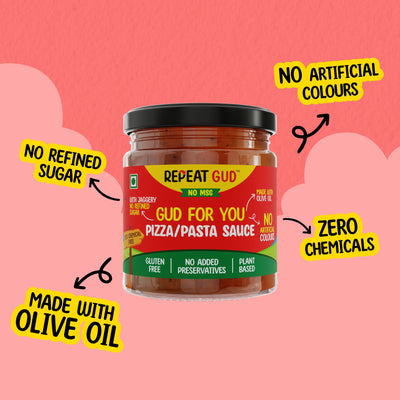
Sweetness from the natural fibre of jaggery instead of refined sugar , flavour without the insulin spike.
Check the first three ingredients. Ours read Water, Tomato Paste, Jaggery not Sugar, Vegetable Oil, Modified Starch.
No "Heart Healthy" sticker required no palm oil, no soy oil, no unnecessary chemicals, so the nutrition takes care of itself.
The ReceiptsWhAT's AcTUALLy IN THE REPEAT GUD BoTTlE
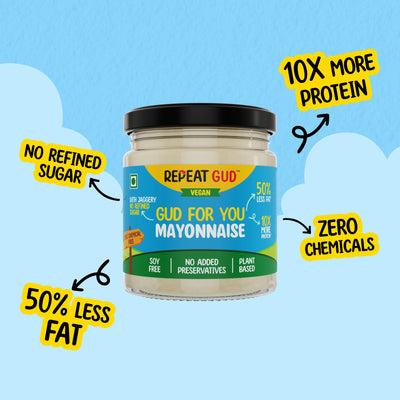
This is exactly why we built REPEAT GUD's Mayonnaise differently. Regular mayo is Villain 02 in a jar , heavy on palm or soy oil, empty on protein. Ours flips that script, per our own product listing:
The protein number matters more than it looks. Harvard Health notes that protein is one of the few nutrients that reliably helps you stay full for longer the exact mechanism regular mayo's oil filler skips entirely. Pea protein powder gives our mayo that nutrient, instead of empty-calorie oil doing all the work. Made with cashew milk, cold-pressed sunflower oil, organic jaggery, and Himalayan pink salt not a shelf-life science project.
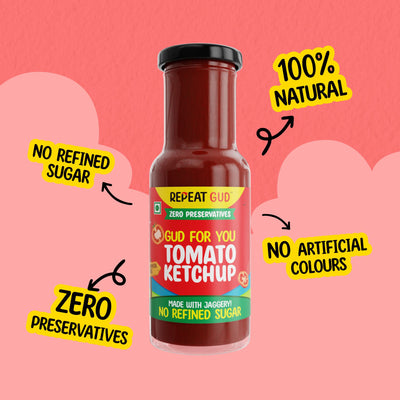
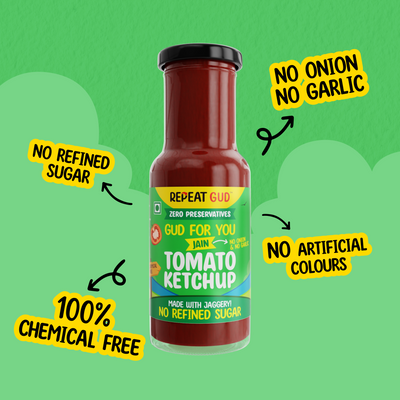
Same logic runs through our Tomato Ketchup: jaggery instead of refined sugar, Himalayan pink salt instead of bleached table salt, zero sodium benzoate, and an 11-ingredient label you can actually read out loud.
The Honest Answer"BuT DIdN't You JusT SAY SAUce Is THE PROblem?"
Fair question. The villain in this story was never sauce as a category , it was hidden sugar, palm oil, and chemical thickeners wearing a health halo. Swap those specific things out, and the "problem" disappears with them.
You don't need to give up ketchup on your fries or mayo on your sandwich to hit your goals. You need the version that doesn't quietly add 180 untracked calories of sugar and oil filler to a plate you worked hard to get right. That's the entire difference between a Trojan Horse and an actual ingredient.
Add These to Your Meal Plan
Flavour that doesn't fight your macros.
AnsweredFREOUENTLY Asked QuEsTIons
Do condiments actually affect weight loss?
Is ketchup bad for weight loss?
Is there a healthy mayo alternative in India?
Why do low-fat sauces sometimes not help with weight loss?
What should I check on a sauce label before buying?
How many hidden calories can ketchup and mayo add per day?
Does protein in a sauce actually help with weight loss?
Is Himalayan pink salt used in REPEAT GUD's weight-loss-friendly sauces?
STOP LoggINg EvERYThINg ExcEpT ThE ThING ThaT MaTTERS
50% less fat. 10x more protein. Zero refined sugar. The sauce aisle's most-skipped step, solved.



