


Is Himalayan Pink Salt Actually Worth the Hype?
We put the ₹300-a-jar pink stuff up against your everyday table salt , the sodium, the "84 minerals" myth, and the one nutrient nobody mentions on the label.
Chemically, Himalayan pink salt and table salt are almost identical, both are mostly sodium chloride, and neither is a health miracle. The real difference is processing, not nutrition: table salt is bleached and dosed with anti-caking chemicals, while Himalayan salt is unrefined. That's why REPEAT GUD uses it across the whole sauce range , not for a superfood claim, but for a cleaner label.
we were scanning the condiment aisle recently and noticed a pattern. Brands love to slap "Natural" or "Himalayan Pink Salt" on a label and suddenly the price jumps by 30%.
Ask people why they buy it, and the answer is usually the same: "I don't know, I heard it has more minerals. It just... feels healthier, right?"
This is the "Healthy Perception" trap , the same logic that makes us buy brown eggs because they "look" more organic, even though the colour is just down to the breed of the hen. It genuinely bothers us when the food industry sells aesthetics instead of explaining the why.
So let's do what we always do: break down the science of Himalayan pink salt vs table salt, and hand the agency back to you.
Part IThe Sodium Mystery
At the chemical level, table salt and Himalayan salt are almost identical both are primarily sodium chloride. But there's a small "sodium thing" worth knowing: because Himalayan crystals are larger and less compressed, a teaspoon of pink salt can carry slightly less sodium by weight than a teaspoon of fine, tightly packed table salt.
Ranges vary by source and crystal size — Healthline's breakdown and the Cleveland Clinic's comparison both land in similar territory.
But don't be fooled: for your blood pressure, salt is salt. The real win isn't the sodium count , it's the process.
Part IIProcess Over Perception
This is where the conversation shifts from nutrition to transparency and why so many clean-label sauces in India are quietly making the switch.
Table salt is an industrial product. To get that uniform, free-flowing white grain, it typically goes through:
Himalayan salt, by contrast, is generally unrefined mined, crushed, and washed. No bleach, no industrial additives.
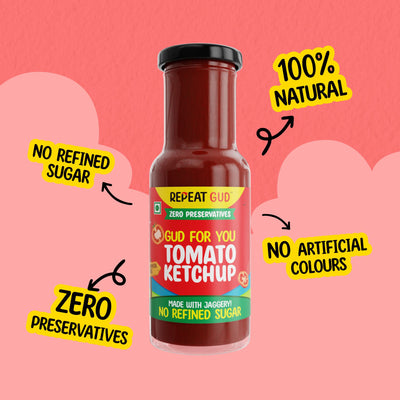
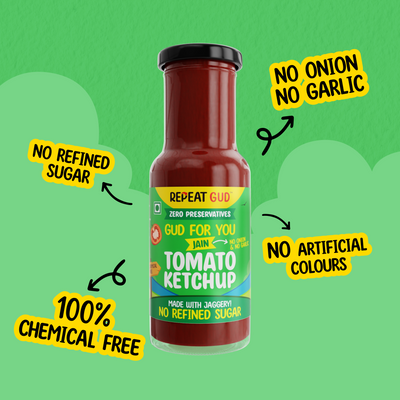
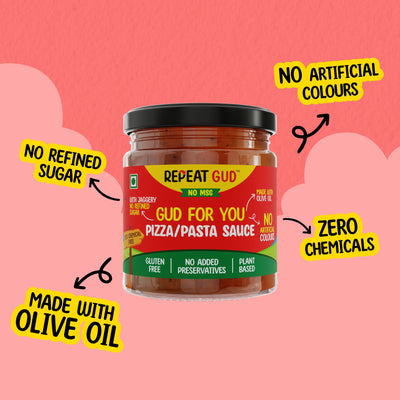
At REPEAT GUD, we use Himalayan pink salt in our Tomato Ketchup, Jain Ketchup, and Pizza/Pasta Sauce for exactly this reason. We aren't chasing a superfood claim , we're chasing a cleaner label: no refined sugar, no unnecessary chemical processing. The less the industry messes with our ingredients, the better.
If you're already in the habit of reading ingredient lists, you're going to like what you find here.
Check the Label →Part IIIThe Mineral Hack (And the Water Secret)
You've probably heard about the "84 trace minerals" in pink salt. They're real, but they don't make it a multivitamin , trace minerals make up roughly 2% of pink salt by weight, with the remaining 98% being plain sodium chloride, the same as any other salt.
But there is one legitimate use case: hydration. Pure, RO-filtered water is often "empty" , stripped of natural minerals. A crystal of Himalayan salt in your water can help make it mineral-rich again and support electrolyte balance, since those trace minerals haven't been stripped out by high-heat refining.
Part IVThe Iodine Reality Check Nobody Mentions
Here's the part most "wellness" brands won't tell you: Himalayan salt is not a total replacement for table salt.
Why? Iodine. Table salt in India is mandatorily iodised under food safety regulation, a public health measure that's been running since the 1960s through the government's National Iodine Deficiency Disorders Control Programme. Himalayan salt is naturally very low in iodine. Go 100% pink without getting iodine from seafood, dairy, or another fortified source, and you're inviting a real nutritional gap , not a myth, a documented one.
For more on what iodine deficiency actually looks like, WebMD's breakdown of Himalayan salt is a solid, balanced starting point.
Head-to-HeadHimalayan Pink Salt vs. Table Salt
| Himalayan Pink Salt | Table Salt | |
|---|---|---|
| Primary composition | Sodium chloride | Sodium chloride |
| Sodium per teaspoon | Slightly less | Slightly more |
| Bleaching agents | ✕ | ✓ Common |
| Anti-caking chemicals | ✕ | ✓ Common |
| Refining level | Unrefined | Industrially processed |
| Iodine content | ✕ Very low | ✓ Fortified in India |
| Used in REPEAT GUD sauces | ✓ | ✕ |
Neither salt is a miracle ingredient — the meaningful differences sit in processing and iodine content, not in some hidden nutritional edge.
Fact-CheckSalt Myths, Busted
Marginally less by teaspoon, but not enough to change your blood pressure math. It's still sodium chloride.
Bleaching and anti-caking agents are standard in refined table salt , genuinely different from Himalayan salt's process.
Those minerals are real but make up ~2% of the salt. You'd need a dangerous amount of salt to get a meaningful dose.
Genuinely true, and the one real trade-off. Balance it with iodine from food if you switch fully.
The FrameworkThe REPEAT GUD Rule for Your Kitchen
Before you restock your pantry, use this simple framework for choosing between Himalayan pink salt and table salt.
Choose it for cooking and sauces to skip anti-caking agents and heavy refining , it's exactly why it's in every REPEAT GUD bottle.
Add a crystal to your morning glass to give "pure," stripped RO water its minerals back.
Keep a small stash of iodised salt on hand, or make sure your diet gets iodine elsewhere seafood, dairy, or a fortified source.
In short: salt isn't a miracle, but the source matters. We use the pink one across our entire range because we believe in transparency over industrial shortcuts. Let salt be salt , just the cleaner version.
Taste the Himalayan Salt Difference
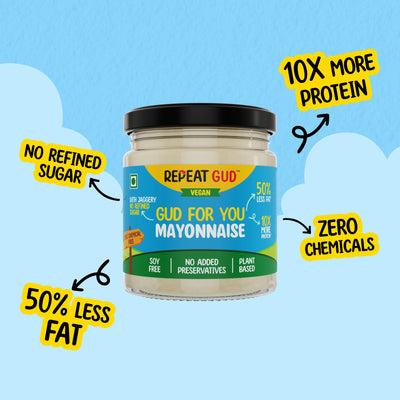
Every REPEAT GUD sauce is made with Himalayan pink salt instead of the bleached, anti-caked stuff. Here's where you'll find it.
AnsweredFrequently Asked Questions
Is Himalayan pink salt actually healthier than table salt?
Does Himalayan pink salt have less sodium than table salt?
What are the real benefits of Himalayan pink salt?
Does Himalayan salt contain iodine?
Why does REPEAT GUD use Himalayan pink salt in its ketchup?
Peek at Your Label. We Dare You.
If it says "refined salt" or lists something you can't pronounce, you already know what to do next.



